
The Consciousness of Trees with Andrew Edgar.
Trees can live for
hundreds, if not thousands, of years.
They are not merely objects for botanical study, but are entwined with
tradition, myth, and folklore. Trees
such as the Major Oak and Tortworth Chestnut are part of the nation’s
history. But should trees be regarded as
conscious beings? Are they aware of and
do they remember the history that unfolds around them? More pertinently, can we use dowsing to
access that consciousness – albeit a consciousness no doubt very different to
our own – and so communicate with a tree?
We know that
plants reacting to their environments.
Phototropism, where a plant responds to and tracks the light of the sun,
is a common phenomenon. But plants such
as the runner bean or bougainvillea probe their surroundings with tendrils,
that can then wrap themselves around suitable supports, allowing the plant to
climb and spread. It can, of course, be
argued that such actions are merely mechanical, causal responses to physical
stimuli.
But, there has
long been a recognition that plants are consciously aware of their
environments. In experiments in the
1960s, Cleve Backster sought to use a lie detector to establish whether a
rubber plants might ‘feel’ pain. The
plant reacted, not to the experience of being damaged, but seemingly
telepathically to Backster’s mental intention to damage it.
More recently the
work of Peter Wohlleben and Suzanne Simard has begun to demonstrate plants’
complexity, both as individual and social beings. They do not merely react to their environment
but communicate with each other about it.
In Africa, acacia trees that are being eaten by giraffes are known to
send chemical signals, carried on the wind, to neighbouring acacias. This stimulates the neighbours to pump toxins
into their leaves, making them unpalatable to the predator. Perhaps this is again merely a mechanical
response. But Wohlleben, a German
forester by trade and experience, argues that individual trees have
personalities, in that neighbouring trees of the same species will, for
example, react differently to the onset of winter. One will rush to lose its leaves, battening
down as it were, while another will hold onto its leaves far longer,
photosynthesising the last, precious, autumnal sunlight.
Simard, a Canadian
academic, has proposed the idea of the ‘wood wide web’, arguing that trees are
linked together by their roots and the mycelia of fungi. This web or network of roots and mycelia
allows trees to communicate with each other (for example warning about
predators), but also to support each other by sending nutrients. Any given group of trees will have a
mother. This is an older, more
experienced tree, that nurtures and protects those around it.
My personal
experience of what I suspect is the telepathic power of trees to communicate
came during a BSD conference in Moreton-in-Marsh. One session was held at Batesford
Arboretum. The small band of dowsers
noticed a group of redwoods. They looked
and felt troubled, so we agreed to take a moment to send healing to them. During this healing I felt the existential
dread of one of the trees. It feared for
the survival of its species. This was a
time of catastrophic forest fires in California that were threatening very
ancient redwood forests. This tree was
aware of the plight of its California relatives. The experience was at once deeply disturbing,
but also enlightening – a privileged insight into the consciousness of trees.
Trees have played
their part in dowsing for many years, and in more than merely providing the
traditional dowser’s v-shape stick.
Trees can provide an excellent confirmation of water dowsing, for
example. Alder and willow are water
loving trees. They will grow above a
water line. Guy Underwood saw, in the
1960s, how trees interacted with earth energies. An energetic spiral could twist a tree’s
trunk and branches, and a line might stunt the growth of the hedge through
which it passed.
Whitethorn, or May, is a quietly remarkable tree. It often seems to be the home of the guardian of a site, and I have found whitethorn guarding the entrances to earth works such as Maiden Castle and Mount Caburn. On top of the South Downs, on Windover Hill, near Wilmington in East Sussex, there is a lone whitethorn (see image 1). But this tree is the home of the guardian of the long barrow that runs beside it, and dowsing brings out the sinuous earth energy lines that connect it to the barrow (see image 2).
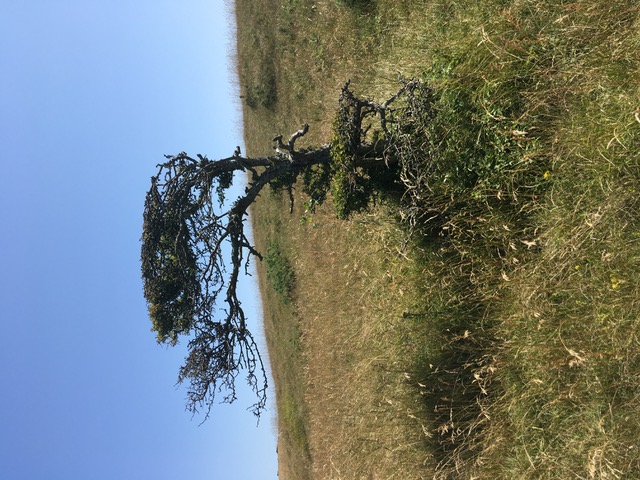
Image 1
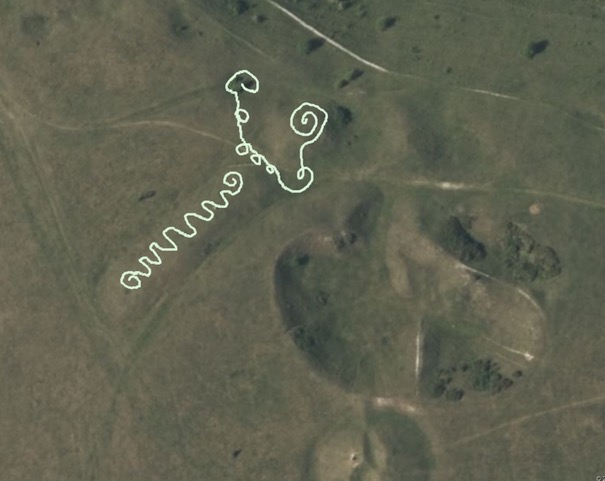
Image 2
Many of us, as
part of our first introduction to dowsing, will have been asked to dowse for
the auras of a tree. We are invited,
once we have the tree’s permission, to walk, slowly, towards the tree, until
our rods cross. This marks the outer
boundary of the aura. When we try to
dowse for that boundary a second time, we will typically find that it has moved
outwards. The tree responds to our
presence and our dowsing. This is
already indicative of the conscious awareness that the tree has of the
environment around it.
Trees do not always have individual auras. A group of trees will be enclosed in a single aura, and this is reminiscent of Simard’s idea of the mother tree. Even in a little spinney (see image 3), one can find trees embracing and protecting others, their auras merging into one. But equally, one can find trees resisting that encroachment, and there will be a strongly defined boundary, as two trees separate themselves from each other.
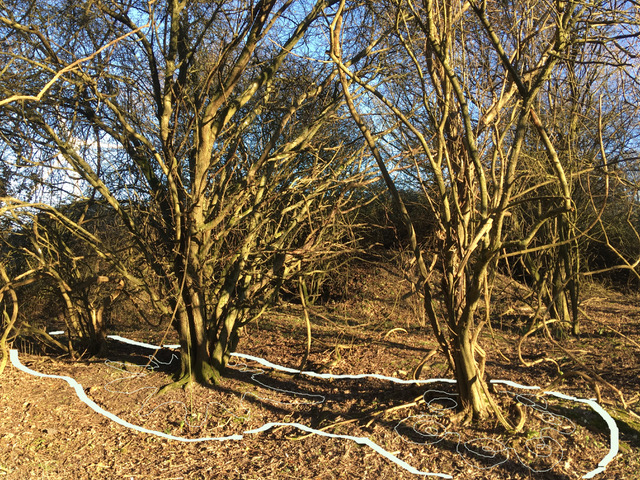
Image 3
We can go
further. Firstly, auras do not, in my
experience, typically form simple circles around the tree. Rather, the aura seems to notice and shape
itself around features in the landscape.
A tree in a church yard will have an aura shaped by features such as
grave stones, for example.
Secondly, within
the tree’s aura we can find flows of energy.
In effect, we find what Hamish Miller called glyphs, although perhaps we
can think of these as sigils – originally a sigil was the name of a demon or
angel, albeit a name that could not be pronounced, only expressed as a complex
pattern. We can dowse the name of the
tree.
Using a single dowsing rod as a pointer, the dowser can ask to be shown the patterns within the tree’s aura. Beginning at the outer edge of the aura, the dowsing rod will lead the dowser on a little dance of twisting and spiralling lines, generally towards the tree trunk. Image 4 shows a fragment of the pattern within an ash tree’s aura in a churchyard in East Sussex.
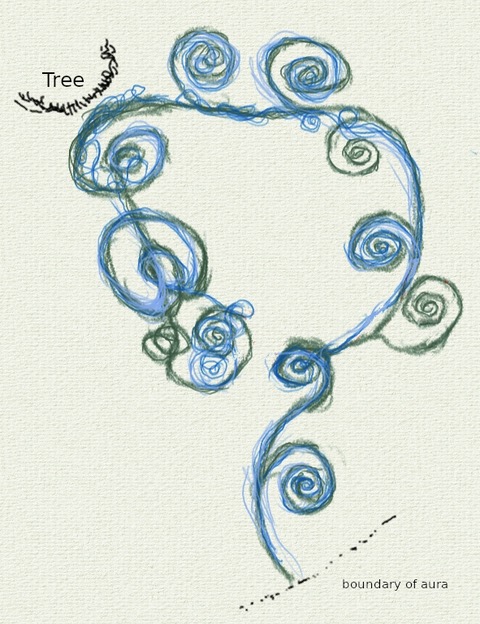
Image 4
Most auras are
very active, and it is difficult to record anything more than a fleeting moment
– a snapshot – of the movement. In a
process akin to automatic drawing – allowing the unconscious mind to guide a
pen – the initial record of the patten can be enhanced and given life. (Dowsing over a colour grid before will allow
you to establish which colours to use.)
I found a remarkable example of an aura associated with an ancient yew in Wilmington (images 5 and 6). The tree is reputed to be 1600 years old. But the aura lacked dynamism. It was grey, composed of repeated undulating circles, and seemingly taking no notice of its surroundings. Perhaps we have strived too hard to keep this tree alive, and it is now time to allow it, gracefully, to pass to the next stage of its existence.
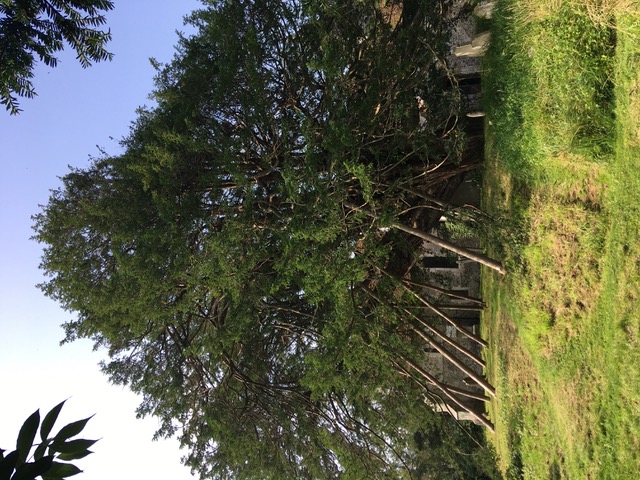
Image 5
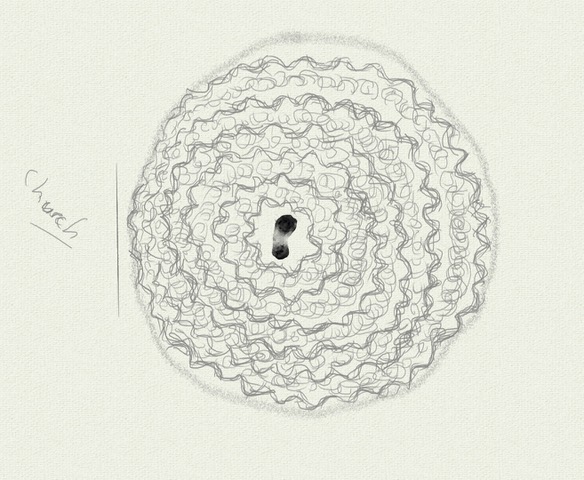
Image 6
This last example
indicates how we might use dowsing to communicate with trees. We can readily find their auras, and more
importantly the patterns within the auras, and the lines of energy that link
the tree to other features in the landscape.
These lines may well be lines of communication – the tree sensing and
‘talking’ to other trees and to the objects around it, in a process that is
complementary to, and perhaps a component of, Simard’s wood wide web. Landscapes are not simply concatenations of
separate objects, but communities, chattering, arguing, and caring for each
other. Careful, respectful dowsing may
allow us to enter into the conversation.
Further reading:
Richard Mabey, Flora
Britannica, 1996
Suzanne Simard, Finding
the Mother Tree, 2021
Guy Underwood, Pattern
of the Past, 1968
Lyall Watson, Supernature,
1973
Peter Wohlleben, The
Hidden Life of Trees, 2017